Kolvirex
Flow Module
Flow Module
Couldn't load pickup availability
1. Problem Statement
Many learners can read short Kotlin examples, but they may feel unsure when the code begins to move through several steps. A value may be created in one line, checked in another line, passed into a function, and then used inside a repeated action. When these parts appear together, the learner needs more than definitions; they need a way to follow the movement of information from one part of the example to another. Another common challenge is that repeated actions and functions are often introduced too briefly, even though they are important for reading larger Kotlin examples. Flow Module was created for learners who want to understand how small Kotlin parts connect inside a more organized study path.
2. Solution
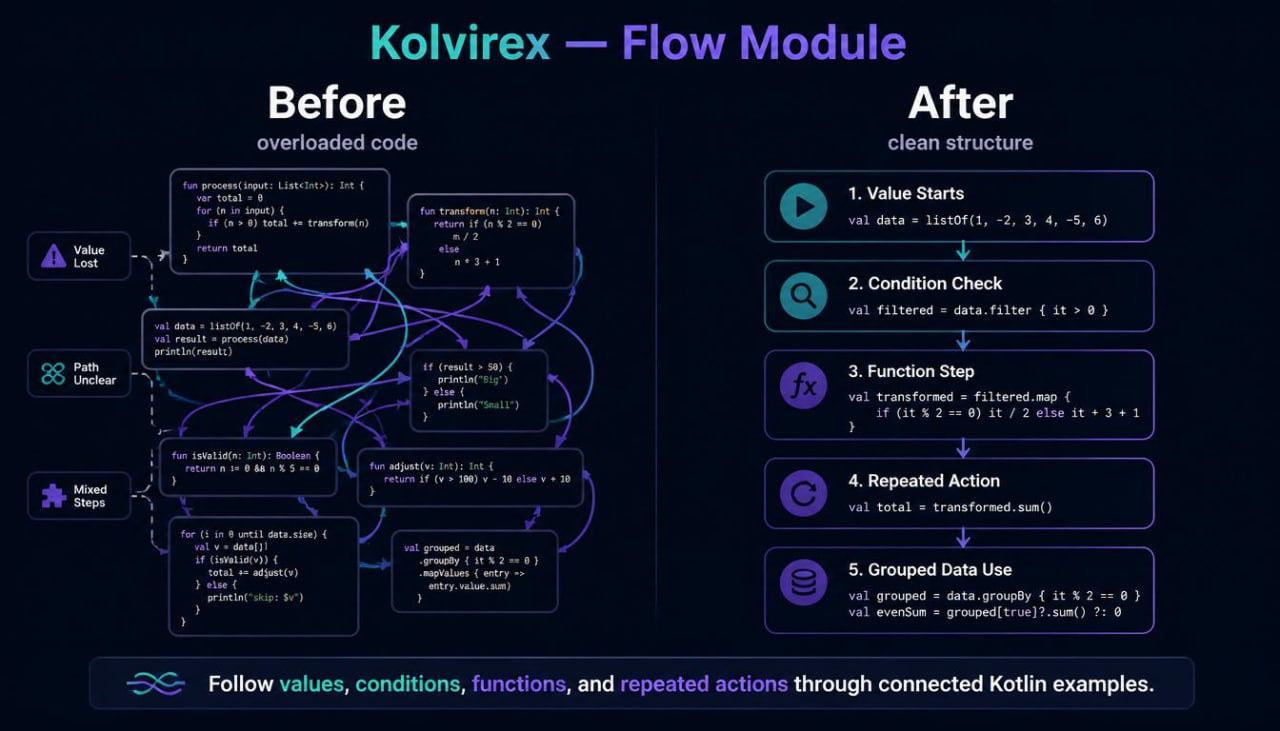
Flow Module explains Kotlin flow through written sections that connect values, conditions, repeated actions, functions, and grouped data. The course uses short code-style examples first, then slowly expands them into examples with several connected steps. Each module includes explanation notes, practice prompts, and recap pages that support careful review. The materials focus on reading flow, tracing values, and understanding how one part of a code block relates to another. This gives learners a practical way to study Kotlin structure without jumping into crowded examples too early.
3. What’s Inside
Flow Module begins with an orientation section that explains the purpose of this tier and how the study file is arranged. This opening part helps learners understand that the course is focused on movement inside code: where a value begins, how it changes, how it is checked, and how it can be used inside another part of an example. The orientation also explains how to use the practice pages, recap notes, and glossary pages while studying at a personal pace.
The first main section reviews Kotlin values and naming patterns. Learners revisit text values, number values, true-or-false values, and named variables in a more connected way. Instead of only showing isolated examples, this section demonstrates how a named value can appear in several places within one small code-style block. The learner sees how a value can be created, read, compared, and reused. Short notes explain why clear names matter and how naming choices can make a code example easier to follow.
The next section introduces value tracing. This is one of the core parts of Flow Module. Learners are shown small examples where a value changes or moves through several lines. The notes ask the learner to follow the value from its starting point to its later use. This helps the learner develop a habit of reading code in sequence, rather than treating each line as a separate item. Practice prompts may ask the learner to mark where a value begins, where it is changed, and where it affects a later result-style line.
A detailed section on conditions follows. This part explains how Kotlin conditions can guide different paths inside an example. Learners study if-style checks, comparison patterns, and combined condition notes. The materials show how a condition can decide which line is used next or how a value is handled. Several examples compare small changes in values so learners can see how the flow changes when the condition changes. The focus is on understanding the path through the code rather than memorizing a rule.
Flow Module then moves into repeated actions. This section explains how a repeated action begins, what happens during each round, and where the repeated part ends. Learners study simple number-based repetition, item-based repetition, and repeated review of grouped values. The examples are written to show how a repeated action can handle one item at a time. Notes beside the examples explain what stays the same, what changes, and how the learner can read the repeated structure without confusion.
The course includes a focused module on functions. This section explains how a function can hold a named task, receive input-style values, and return a result-style value. Learners study how function names should describe the task, how input-style values are placed inside the function, and how the result can be used later. The examples show functions that work with text, numbers, and simple true-or-false checks. Practice tasks ask learners to identify function parts, describe the function flow, and complete small missing sections.
Another important part of Flow Module covers the connection between functions and conditions. Learners see how a function can include a condition, and how that condition can guide the result. This section is useful because many learners first study functions and conditions separately, then feel unsure when they appear together. The course explains this combination through short examples with plain notes. Learners are asked to follow the input-style value into the function, read the condition, and describe the result.
The next section introduces collections in a practical way. Learners study how several values can be grouped together and reviewed one by one. The course explains list-style examples, item reading, and repeated actions connected with grouped values. The examples remain small but are more connected than earlier tiers. Learners see how a collection can hold several items, how a repeated action can move through them, and how a condition can check each item.
A mixed flow section appears near the end of the course. This part combines values, conditions, functions, repeated actions, and collections in guided practice examples. The tasks are written to help learners trace the full movement of an example from beginning to end. A learner may be asked to follow a value into a function, check which condition is used, read a repeated action, and explain the final result in plain language. These tasks are not written as large projects. They are small study exercises built to strengthen code reading habits.
Flow Module also includes recap pages after each larger topic group. These pages summarize key ideas in short notes, making it easier to return to the course later. The recap pages include reminders about value tracing, condition flow, repeated action structure, function parts, and collection reading. A glossary near the end explains terms from the course, including variable, expression, condition, comparison, function, input-style value, result-style value, collection, item, and repeated action.
The final study direction page gives learners a calm overview of what can come after this tier. It points toward broader code organization, deeper collection work, and more practice with connected examples. The page is written as a study suggestion rather than a promise about outcomes.
4. Who Is This For?
Flow Module is for learners who already know some basic Kotlin terms and want to understand how those terms work together inside a code-style example. It is suitable for learners who can read short examples but feel less certain when values, conditions, functions, and repeated actions appear together.
This course may also fit learners who like to study with written explanations and small practice prompts. The materials are arranged for people who prefer to slow down, trace each part, and review the same idea from several angles. It is not built around rushed study or oversized examples. Instead, it supports careful reading and steady topic connection.
Flow Module can be useful for learners who have completed an earlier Kolvirex tier and want a stronger bridge into wider Kotlin material. It gives more attention to how code moves, how values travel through examples, and how repeated structures can be read. Learners who often lose track of where a value came from, or where a function result is used, may find this tier especially helpful.
It is also a good fit for learners who want more practice before studying larger code organization topics. The course keeps the examples small enough to follow while adding enough connection between topics to make the study feel more complete.
5. What You’ll Learn
- How to follow the movement of values through short Kotlin examples
- How named values can be created, reused, compared, and changed
- How to trace a value from its starting point to later use
- How conditions guide different paths inside a code-style block
- How comparison patterns affect the flow of an example
- How repeated actions begin, continue, and end
- How repeated actions can work with numbers and grouped values
- How functions hold named tasks and use input-style values
- How result-style values can be returned and used later
- How functions and conditions can work together in one example
- How collections hold several values for review and practice
- How repeated actions can move through grouped items
- How to read mixed examples with values, functions, conditions, and collections
- How to use recap notes to review connected Kotlin topics
6. 30-Day Refund Note
For paid Kolvirex course tiers, a 30-day refund option may be offered according to the terms shown on the store page at the time of purchase. If Flow Module does not match the learner’s study needs, they may contact Kolvirex support within the stated refund window.
Self-paced learning overview
- 🗂️ Digital file available after purchase
- 🧭 Long-term availability
- 🔒 Secure checkout
- 📝 Content updated in 2026
What format are Kolvirex courses provided in?
What format are Kolvirex courses provided in?
Kolvirex courses are provided as digital study materials with written modules, code-style examples, practice tasks, review notes, and topic summaries. The materials are made for self-paced reading and repeated review.
Do I need previous Kotlin knowledge before starting?
Do I need previous Kotlin knowledge before starting?
No previous Kotlin study is required for the early course tiers. The starting materials introduce basic terms, simple syntax ideas, readable examples, and small practice tasks.
Can I study at my own pace?
Can I study at my own pace?
Yes. Kolvirex courses are arranged into sections, so you can study one part at a time, return to earlier notes, and repeat exercises when needed.
Share