Kolvirex
Free Capsule
Free Capsule
Couldn't load pickup availability
1. Problem Statement
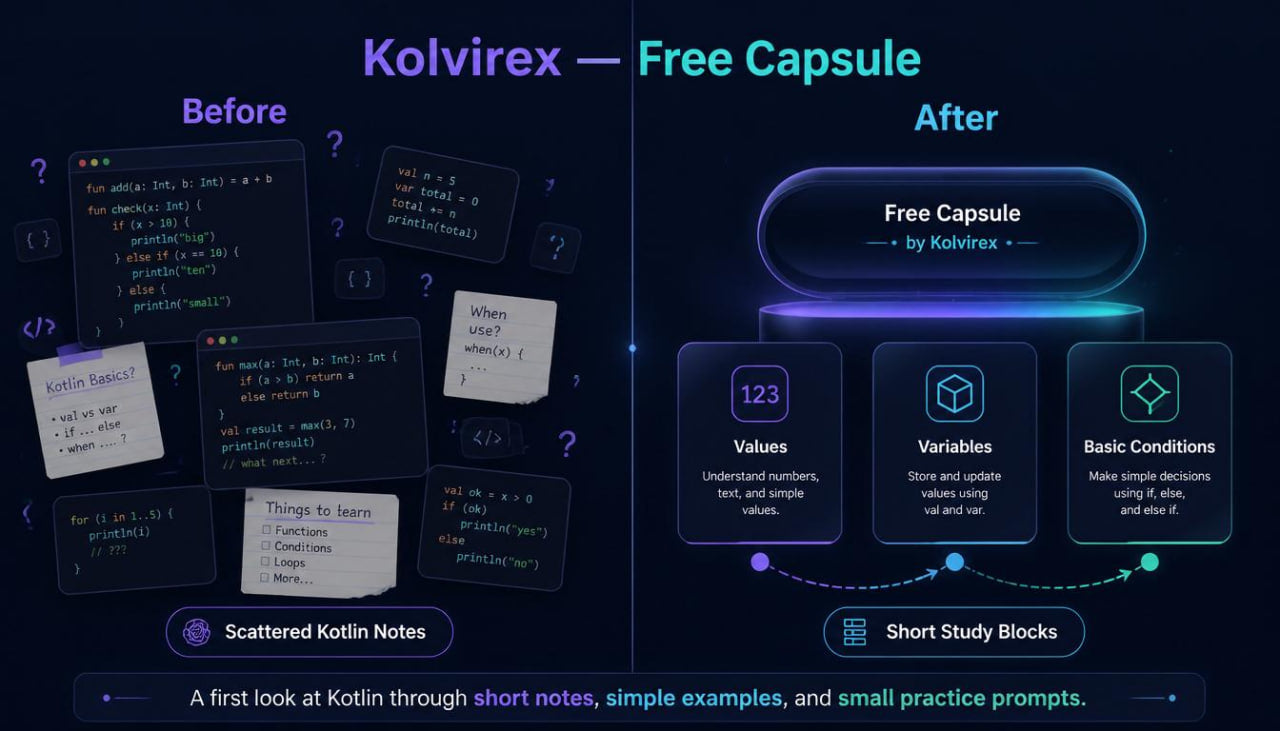
Many learners begin Kotlin with scattered articles, mixed explanations, and examples that introduce too many ideas at once. A simple variable can appear beside functions, conditions, object structure, and longer code blocks before the learner has time to understand each part. This can make the first study session feel noisy, even when the topic itself is not too complex. Some learners also need a small sample before choosing a wider course, because they want to see the writing style, pacing, and task format first. Free Capsule was created for that first careful look, without pressure, heavy theory, or large topic jumps.
2. Solution
Free Capsule offers a compact Kotlin study file built around short explanations, readable notes, and small code-style examples. The course begins with beginner-friendly topics and presents them in a clean order, so each section has one main idea. Instead of pushing many concepts together, the material uses small study blocks that can be reviewed more than once. Practice tasks are included to help learners work with basic syntax, simple values, and short logic patterns. This makes Free Capsule useful as a first sample of the Kolvirex learning style before moving into larger course tiers.
3. What’s Inside
Free Capsule includes a focused selection of Kotlin study materials made for a first reading session. The course begins with a short orientation section that explains how the file is arranged, how to move through the sections, and how to use the notes without rushing. This opening part is helpful for learners who prefer a planned study path rather than jumping straight into longer code examples.
The first learning section introduces Kotlin as a language structure, focusing on how written code is arranged, how values are named, and how short instructions can be read from top to bottom. The explanation avoids heavy terminology at the start and instead uses plain descriptions of what each part of a small code sample is doing.
The course then moves into basic value notes. This section introduces simple variables, readable names, text values, number values, and the idea of storing information for later use in a small code block. Each idea is explained with short examples, followed by small notes that point out common beginner confusion, such as the difference between naming a value and using that value later.
Another part of Free Capsule introduces basic output-style examples. These examples show how a small instruction can display or return a piece of text in a learning context. The purpose is not to cover every option, but to help the learner read a short code line and understand its parts.
A short section on conditions is also included. This part introduces the idea of checking whether something is true or false in a simple written example. The learner sees how a condition can guide what happens next in a small code structure. The examples stay short so the focus remains on reading and understanding the flow.
Free Capsule also contains practice prompts. These are small tasks written in plain language, asking the learner to rename values, complete short examples, identify parts of a line, or explain what a tiny code block is doing. The tasks are not built around pressure or scoring. They are intended for quiet review and self-checking.
The course includes recap notes after the main sections. These summaries gather the key ideas from the file into shorter review points. Learners can use them after reading the full material or before repeating the practice tasks. The recap section is especially useful for learners who like to return to a topic later and refresh the main ideas without rereading every paragraph.
A small glossary is included near the end. It explains common beginner terms in simple wording, including value, variable, condition, expression, and syntax. The glossary is written to support the course sections rather than replace the full explanations.
Free Capsule also includes a short “next study direction” page. This page does not make large claims or push the learner into a specific result. It simply shows which topics can be studied after the sample, such as functions, collections, loops, and wider code organization.
4. Who Is This For?
Free Capsule is for learners who want a small, no-cost introduction to the Kolvirex course style. It is suitable for people who are new to Kotlin and want to see how basic concepts can be explained in a calm written format. It is also useful for learners who have seen Kotlin before but want to review the starting points again with short notes and simple practice.
This tier works well for learners who prefer reading over long presentations. The material is based on written modules, structured examples, and review-friendly sections. It does not require previous coding background, although learners who already know basic programming terms may still find the sample helpful as a way to understand how Kolvirex arranges its course files.
Free Capsule is also a good fit for people comparing course tiers before choosing a larger set of materials. Since it shows the structure, tone, and pacing of Kolvirex study files, it gives learners a practical look at how the paid tiers are likely to feel. The sample is small by design, so it does not try to cover a wide topic range. Instead, it focuses on giving a readable first impression.
It may also be helpful for learners who feel overwhelmed by crowded learning pages. Free Capsule keeps each section focused, uses short examples, and gives space between ideas. This helps create a more organized reading experience.
5. What You’ll Learn
- How basic Kotlin study notes can be read in a structured order
- How simple values and variables are described in beginner-friendly wording
- How short code-style examples can be broken into smaller parts
- How text values and number values can appear in simple examples
- How basic condition patterns can guide a small code flow
- How to read short syntax examples without jumping into larger projects
- How to use recap notes for review after a first reading
- How to complete small practice prompts based on beginner topics
- How to recognize common terms such as value, variable, condition, expression, and syntax
- How Kolvirex arranges written modules, task pages, and glossary notes
6. 30-Day Refund Note
Free Capsule is provided at no cost, so no payment is required for this tier. For paid Kolvirex course tiers, a 30-day refund option may be offered according to the refund terms shown on the store page at the time of purchase.
Self-paced learning overview
- 🗂️ Digital file available after purchase
- 🧭 Long-term availability
- 🔒 Secure checkout
- 📝 Content updated in 2026
What format are Kolvirex courses provided in?
What format are Kolvirex courses provided in?
Kolvirex courses are provided as digital study materials with written modules, code-style examples, practice tasks, review notes, and topic summaries. The materials are made for self-paced reading and repeated review.
Do I need previous Kotlin knowledge before starting?
Do I need previous Kotlin knowledge before starting?
No previous Kotlin study is required for the early course tiers. The starting materials introduce basic terms, simple syntax ideas, readable examples, and small practice tasks.
Can I study at my own pace?
Can I study at my own pace?
Yes. Kolvirex courses are arranged into sections, so you can study one part at a time, return to earlier notes, and repeat exercises when needed.
Share