Kolvirex
Slate Pattern
Slate Pattern
Couldn't load pickup availability
1. Problem Statement
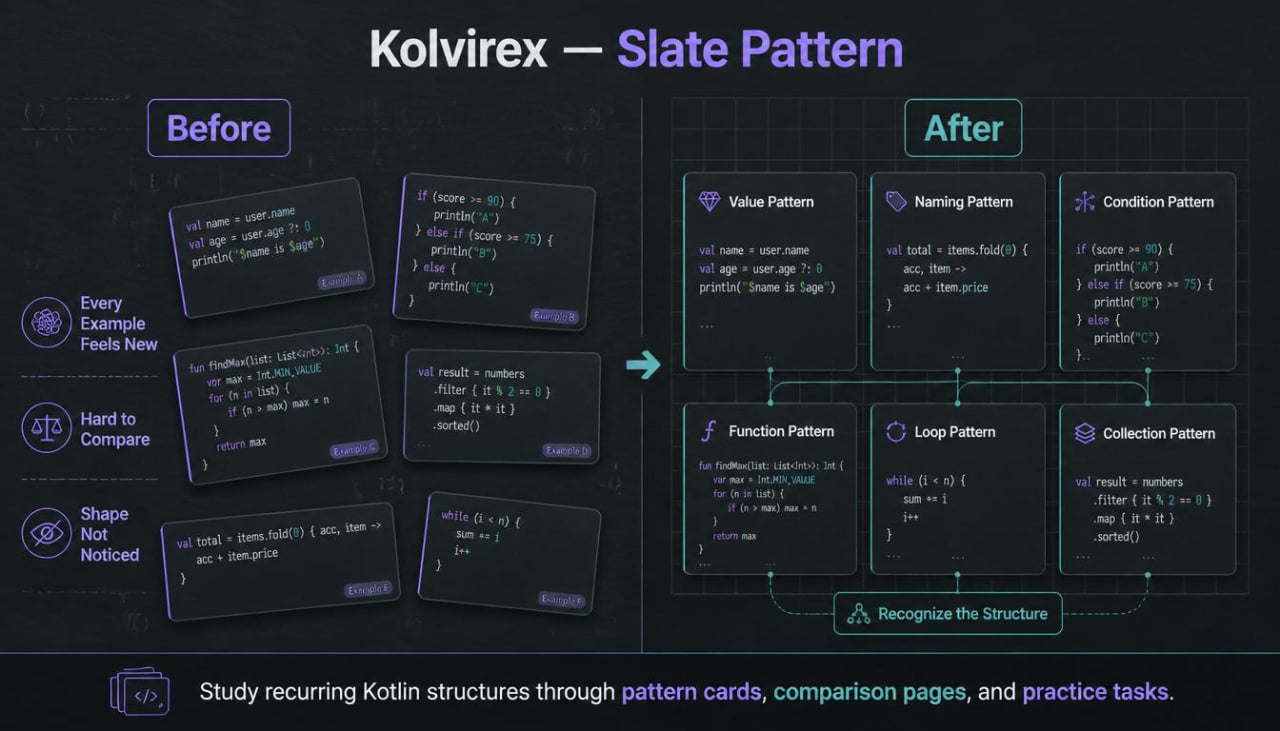
As Kotlin examples become wider, many learners begin to notice that the same ideas appear again and again, but not always in the same shape. A condition may appear inside a function, a function may work with a grouped value, and a repeated action may use a condition during each round. When these patterns are not explained clearly, learners may treat every example as completely new, even when it is built from familiar parts. This can make study feel heavier than needed because the learner keeps restarting instead of recognizing repeated structures. Slate Pattern was created for learners who want to study these recurring shapes in a calm, organized way.
2. Solution
Slate Pattern teaches Kotlin through pattern-based written modules. Instead of only listing terms, the course shows how familiar structures repeat across different code-style examples. Learners study one pattern at a time, review how it is shaped, and then compare it with related examples. Practice tasks ask learners to identify patterns, complete missing parts, rewrite short sections, and explain how a structure works in plain language. This helps learners move from isolated topic reading toward more connected Kotlin study.
3. What’s Inside
Slate Pattern begins with a course orientation that explains the idea of pattern-based study. The opening pages show learners how the materials are arranged and why certain code shapes return across the course. This section introduces a simple approach: first identify the structure, then read the parts inside it, then describe what the structure is doing. The orientation also explains how to use recap notes and practice prompts while moving through the file.
The first main module focuses on value patterns. Learners revisit text values, number values, true-or-false values, named variables, and simple expressions. The course shows how these values appear in repeated shapes across several examples. A named value may be created in one line, compared in another, and then passed into a function later. The notes explain how to follow this pattern without losing track of where the value came from.
A second module studies naming patterns. Learners review how names are selected for values, functions, and grouped items. This section includes examples where a clear name helps the learner understand the purpose of a line, as well as examples where a vague name makes the structure harder to read. The practice prompts ask learners to rename small parts of an example and explain why the new name fits the task better.
Slate Pattern then moves into expression patterns. This module shows how values can be combined, compared, adjusted, or prepared for another part of the code-style block. Learners see number-based expressions, text-based expressions, comparison expressions, and true-or-false checks. Each pattern is shown in several forms, so learners can compare what changes and what stays the same. The explanations focus on reading structure rather than memorizing wording.
A detailed condition module follows. Learners study how conditions are shaped and how they guide movement through a code-style example. The course begins with single-condition patterns, then moves into examples with more than one check. It explains how to identify the question inside a condition, how to read the answer path, and how to understand the line that comes after the check. Practice tasks ask learners to mark the condition, predict the path, and rewrite the condition in plain wording.
The course includes a module on repeated action patterns. This section explains how repeated blocks are built, what changes during each round, and what stays consistent. Learners study repetition with numbers, text items, and grouped values. The examples are arranged so learners can see how the same repeated structure can work with different kinds of information. Short notes beside the examples explain the beginning point, the repeated section, and the ending point.
Another major section focuses on function patterns. Learners study how functions are shaped, how they receive input-style values, and how they return result-style values. The course explains why a function name should describe the task, how parameters are arranged, and how the result is placed back into the surrounding example. Learners compare several functions with similar shapes but different purposes. This helps them recognize the shared pattern behind the examples.
Slate Pattern also includes a module on function-and-condition combinations. This section shows how a function can receive a value, check that value, and return a result based on the check. Learners follow the input-style value into the function, read the condition, and then follow the result back out. The course uses short examples so the pattern stays visible. Practice tasks ask learners to label each step and describe the movement in simple words.
The next section introduces collection patterns. Learners study how grouped values are arranged, how items are read, and how repeated actions can move through a group. The examples show grouped text values, grouped number values, and simple item checks. The course also explains how a condition can be used while reviewing each item. This helps learners understand how collections, repetition, and conditions can work together inside one study example.
A separate comparison module helps learners look at similar code-style examples side by side. One example may use a simple condition, while another uses the same condition inside a function. One example may repeat through a group, while another checks each item during repetition. These comparison pages are one of the main parts of Slate Pattern because they train the learner to notice structure. Each comparison includes short questions that guide the learner through the differences.
The mixed practice module brings together values, expressions, conditions, functions, repeated actions, and collections. The examples are wider than in earlier tiers but still arranged for careful reading. Learners are asked to identify the main pattern, mark important parts, explain the flow, and complete small missing sections. These tasks help learners connect different topic groups without turning the course into a large project file.
Slate Pattern includes recap pages after the main modules. These pages summarize value patterns, naming patterns, expression patterns, condition patterns, function patterns, repeated action patterns, and collection patterns. The recap notes are written for review, so learners can return to them after completing the practice tasks.
A glossary near the end explains course terms in plain language. It includes terms such as value, variable, expression, condition, comparison, function, input-style value, result-style value, collection, item, repeated action, and pattern. The glossary is connected to the course wording, making it useful while reviewing earlier modules.
The course ends with a study direction page that suggests broader areas learners may study after completing this tier. These may include larger function organization, wider collection examples, and more detailed practice with combined structures. The page stays practical and does not make outcome claims.
4. Who Is This For?
Slate Pattern is for learners who have already studied Kotlin basics and want to become more comfortable recognizing repeated code shapes. It is suitable for learners who understand individual topics but want more help seeing how those topics appear together in different examples.
This course is a good fit for people who like structured written materials, side-by-side comparisons, and practice tasks that focus on reading. It may be especially helpful for learners who often feel that every new example looks unfamiliar. Slate Pattern shows how many examples are built from recurring parts, which can make study feel more organized.
The tier is also useful for learners who completed earlier Kolvirex courses and want a stronger connection between foundations and wider Kotlin material. It gives more time to functions, conditions, repeated actions, and collections while keeping the examples clear and review-friendly.
Slate Pattern may also fit learners who like to explain code in plain language. Many tasks ask learners to describe what a pattern does, where it begins, how it moves, and what result-style value appears later. This makes the course useful for deeper reading practice.
5. What You’ll Learn
- How to recognize recurring Kotlin code shapes across different examples
- How values appear in repeated structures
- How naming choices affect code-style readability
- How expressions combine values, checks, and operations
- How condition patterns guide different paths
- How repeated action patterns begin, continue, and end
- How functions are shaped around named tasks
- How input-style values move into functions
- How result-style values move back into surrounding examples
- How functions and conditions can form one combined pattern
- How collections hold grouped values
- How repeated actions can review grouped items
- How to compare two similar examples and identify structural changes
- How to complete practice tasks based on values, functions, conditions, and collections
- How to use recap pages and glossary notes for later review
6. 30-Day Refund Note
For paid Kolvirex course tiers, a 30-day refund option may be offered according to the terms shown on the store page at the time of purchase. If Slate Pattern does not match the learner’s study needs, they may contact Kolvirex support within the stated refund window.
Self-paced learning overview
- 🗂️ Digital file available after purchase
- 🧭 Long-term availability
- 🔒 Secure checkout
- 📝 Content updated in 2026
What format are Kolvirex courses provided in?
What format are Kolvirex courses provided in?
Kolvirex courses are provided as digital study materials with written modules, code-style examples, practice tasks, review notes, and topic summaries. The materials are made for self-paced reading and repeated review.
Do I need previous Kotlin knowledge before starting?
Do I need previous Kotlin knowledge before starting?
No previous Kotlin study is required for the early course tiers. The starting materials introduce basic terms, simple syntax ideas, readable examples, and small practice tasks.
Can I study at my own pace?
Can I study at my own pace?
Yes. Kolvirex courses are arranged into sections, so you can study one part at a time, return to earlier notes, and repeat exercises when needed.
Share